“There is No Escaping The Magic Now”: One Hundred Years of the Colorado Poet Laureate
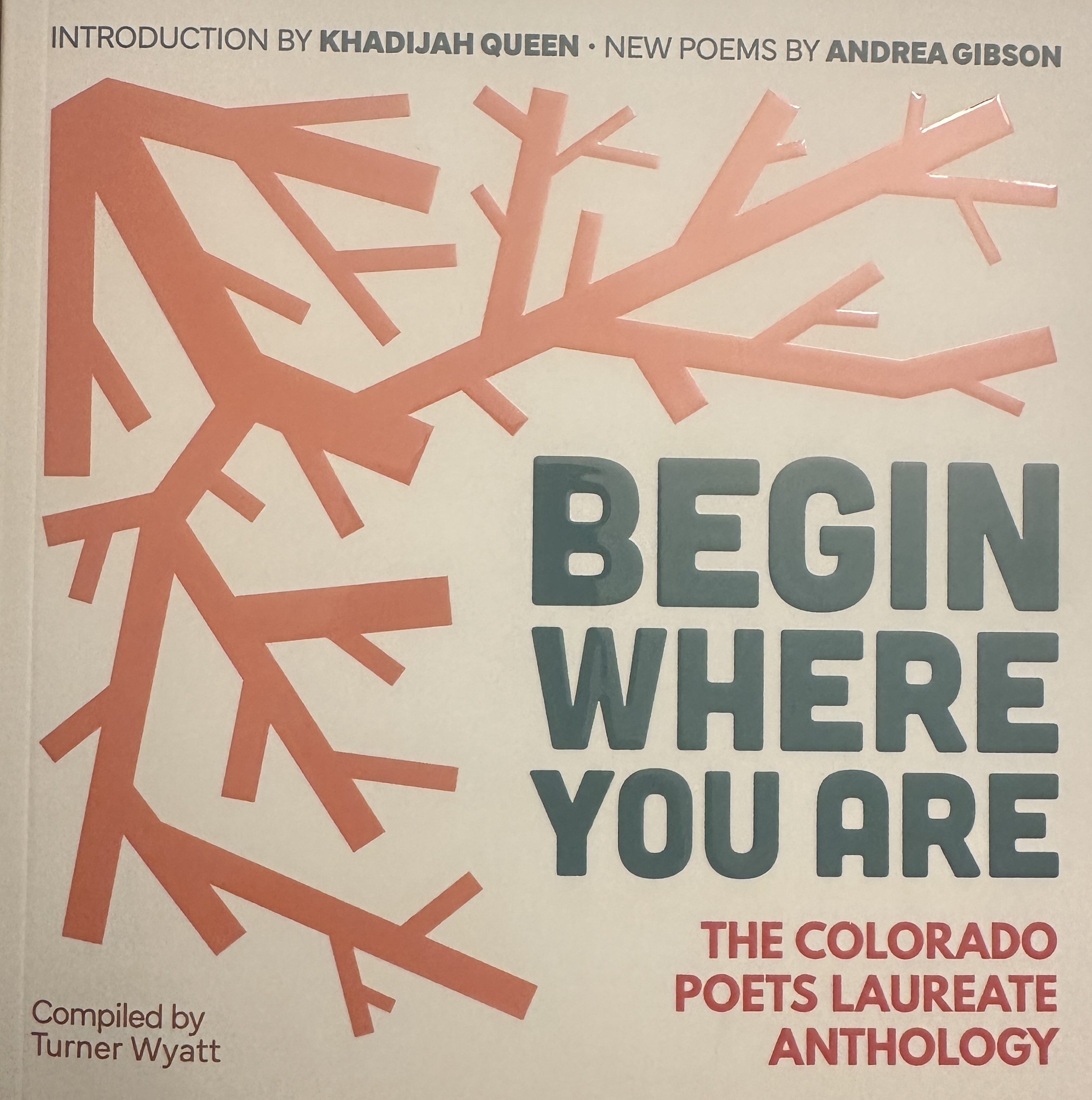
As I write this morning, a poet friend texts me about the launch of Begin Where You Are: Colorado Poets Laureate Anthology, a much-awaited anthology of the work of Colorado’s ten poets laureate over the last century. The brainchild of social entrepreneur Turner Wyatt, this anthology is a celebration and revelation of the poet laureate, from 1919 to the present day, a role which has surely helped to shape the state of poetry in Colorado. Given the fact that my friend reports somewhere between 100-150 poetry lovers who have defied Denver’s crushing rush hour and crammed themselves into the bookstore Pages & Petals to hear our latest poets laureate— Mary Crow, Joseph Hutchison, Bobby LeFebre, David Mason, and the work of the late Andrea Gibson— the poets laureate are, obviously, wildly popular. (Rumor has it that 500 books sold before the launch.)
If you are poet living in Colorado, you probably at one time or another have asked yourself what it takes to be a poet laureate. Being an exceptional poet? Having the heart of a community organizer? And a trustworthy car? Or the stamina to go from library workshops to bookstore readings to festival rites to first grade “crisscross applesauce” fun, all the while continuing to create your own poetry, and, oh, yeah, still working at your full-time job because who can live on what the poet laureate makes? The poems, the told histories, and the candid introductions by the Colorado poets laureate themselves in this anthology suggest a resounding yes to all.
Begin Where You Are is a distinctive and important read for any serious poet living in Colorado, the poet who aspires not just to writing the most authentic of poetry, but who envisions poetry’s power to create the deepest of communities in a vast and disparate state made up of plains and mesas, hogbacks and arroyos, pinnacles and sand dunes and the people who inhabit them:
The poet is more than a writer. The poet is more than literature. The poet is a cultural translator. A humble prophet. A communal visionary.
—Bobby LeFebre (2019-2023)
In the anthology’s Introduction, the poet Khadijah Queen (one of my picks for the next Colorado poet laureate) reminds us why there is so much love for these poets, these traveling bards who have slipped through the years like quicksilver across our state in the service of poetry. It is the aim of the poet to “express the inexpressible through what we observe in order to make real-life connections off the page.” And this is what these poets laureate have achieved, evidenced by the poems in this anthology and their soon-to-be dog-eared pages.
Since 1919, over a hundred and six years now, Colorado has appointed poets as emissaries of the word for all people, not just the erudite academic. And that word, its “endless/irruption of /forms and essences” (Hutchinson, from “Ode to Something) is lyric, politic, narrative, cultural, diverse, necessary. Queen does an excellent job in the introduction of encapsulating the essence of each poet laureate, while I find it difficult here to give you just single bits to savor:
Andrea Gibson (2023-2025), the “emotional heft” of their spoken word poetry and whose diagnosis of a fatal form of cancer early in their tenure shocked the poetry world:
Do you know how many beautiful things
can be seen in a single second? How you can blow up
a second like a balloon and fit infinity inside of it?
— from “In The Chemo Room, I Wear Mittens Made
Of Ice So I Don’t Lose My Fingernails. But I Took A Risk Today To Write This Down”
Bobby LeFebre (2019-2023), youngest and first person of color to be poet laureate, his work paradoxical, filled, as Queen says, with “tactile beauty”:
In the land of my forefathers,
the sun kisses the piñon trees so tenderly
they glimmer emerald in the distance.
The earth and the chile are red.
The adobe has become a caricature of itself.
Turquoise gags as the white woman fetishizes the neo-colonial theft around
her neck.
—from “Santuario”
Joseph Hutchison (2014-2019), current director for University College at the University of Denver, “the rooted watcher”:
I’ve watched
Machines drawling the gouged scarps like famished insects
out of the early Triassic, year after year unearthing a massive
vacancy, turning the cliff-face into money, into how many
stones under how many feet of how many walkers? (Let it
go. Breathe.) I count my steps . . .
— from “Spiral Path”
David Mason (2010-2014), professor, librettist, whose poetry “breaks taboos” and “carries us in the language of memory”:
What was I? Twelve years old? The age I dreamed
Luisa Mole out foraging for water . . .
On our visits south
I begged to be taken to the mesa country
as if those afternoons on skeletal land
put me in touch with some essential code . . .
—from “Stonewall Gap” (excerpted from Ludlow: A Verse Novel)
Mary Crow (1996-2010), traveler, consummate literary poet, her poetry creating “connections to the wider world”:
What was that City
After Cavafy
That tangled me in sandy roots, led me
into desert, where I gasped at
vastness and vacancy, pyramids fringing
miles of nothing growing, a void
I vanished into . . .
—from “What was that City”
Begin Where You Are is organized chronologically, these five contemporary poets presented first and then the first five poet laureates who helped to shape this role. Embedded in the Colorado poet laureate’s history is the spoken and unspoken manifest of community service, beginning with Alice Polk Hill (1919-1921) who first conceived of the idea of the Colorado poet laureate and was promptly appointed by the Colorado governor. Hill, a woman of dynamic civic energy, helped create, among many other literary organizations, The Denver Woman’s Press Club, still an esteemed part of Colorado’s literary landscape. Nellie Berget Miller (1923-1952), an astonishing woman of letters who received honorary advanced degrees at a time when only 5% of the country’s population had even a bachelor’s degree, was our second poet laureate. She, too, founded important literary organizations, including the Colorado Springs Poetry Fellowship. Milford E. Shields (1954-1975), who worked as a movie projectionist at the Durango Rialto Theater, edited the Durango Herald’s poetry column, “Singing San Juan,” producing an astonishing 1200 columns purely on poetry. The work of Thomas Hornsby Ferril (1979-1988), probably Colorado’s best-known poet,is still inscribed on Denver’s capitol building.
Our five contemporary poet laureates share these earlier threads of selflessness, leaving their own desks to travel to the most rural areas of our state and endeavor to build communities of poetry and heart. It seems, too, that within their tenures, these poet laureates found themselves deepening into true ambassadors of poetry, realizing in their travels how so many hungered to find soul in the stuff of stars and in the “traces of sawdust” on a grandmother’s blouse (from LeFebre’s “Magic”).They learned to not only be the conduit voice of poetry that inspires and enflames, but to be its gentle ear, too, for those who are only learning to speak its language:
Throw in Gunnison, Crested Butte, Leadville, and more tiny towns
than I have space to name. In all of them I found people hungry
for the life of poetry.
—David Mason (2010-2014)
Within the pages of this anthology, we discover how Mary Crow brought poetry to children and adults throughout Colorado in vast and giving ways, such as bringing master poets like Kenneth Koch to teach graduate students how to teach children to write. Or how David Mason during his tenure vowed to visit all sixty-four counties in Colorado, missing his goal by just four. Or how Joseph Hutchison redrew his “mental map” of poetry on the Front Range and so began to travel throughout the state reading and teaching poetry. And how Bobby LeFebre bridged the forced isolation of the covid years with creativity and resourcefulness. And how a dying Andrea Gibson burned like clean fire across the world stage.
I would be remiss not to mention how this anthology is a most delectable time capsule, too. Within its pages, embodied (or, more importantly, sometimes not!) in the work of our early Colorado poet laureates is that dizzying kaleidoscopic transformation of poetry from the English tradition-bound “verse” to modernism and our contemporary poetry. Here, for example, is the rhyming narrative poetry of Alice Polk Hill in 1919:
Fair, Joyous child, with wondrous eyes,
The royal purple ‘round thee lies.
How astonishing to realize that Hill was not only writing amidst our western landscape— not a sage brush on the horizon, at least in this selection of work— but also writing in the explosive time of Pound, Eliot, Stevens, and Hughes, those greats of modernist poetry, who shocked the world with tomes like “The Wasteland.” Same with the work of Nellie Berget Miller. Even as her poetry entices us with homey lyrical moments of “gaunt cottonwoods” and “stumbling puppies,” we realize she was writing amidst the rebellions of the Beat poets. Margaret Clyde Robertson, an astonishing 80 years old when she started her tenure, wrote charming narratives about whimsical places like “Tin Cup Town,” while Ginsberg howled at the world. Perhaps you will find yourself, as I did, loving these old-time poets for everything their poetry has and has not. Or admiring in the work of Shields and Ferril, who serve as bridges between the past and now, the rich language of the Colorado landscape and the modern voice of poetry as we know it today, as well as coveting their accolades, such as the Yale Series of Younger Poets award that Ferril received for his first book, High Range.
Nurtured through the development of a non-profit (coloradopoet.com) for funding and edited by Colorado’s most recent poet laureates, Begin Where You Are is a publication of The Center for Literary Publishing at the Colorado State University. Ultimately, there is much to rejoice here. In a time when the arts are threatened, we live in a state where the words of poets continue to be treasured, even by our politicians and governors. The publication of this anthology reminds me of how the many good, community-minded, and caring people who live in just one state, across the span of a century, can tend to a poetry that flourishes for everyone. Buy a copy of this anthology and a portion of every sale of this book “will go toward funding poetry programs in under-served communities in Colorado.” Here is that “magic now,” as Andrea Gibson so aptly puts it in her poem, “Acceptance Speech After Setting The World Record In Goosebumps,” a magic that every other Colorado poet laureate has watched unfold, and that no one wants to escape.

